 |
 |
Here we discuss issues of Accessibility, guides to good practice and some of the 'mistakes' we have encountered.
Some places don't do accessible!
Thames Path near Oxford.
 |
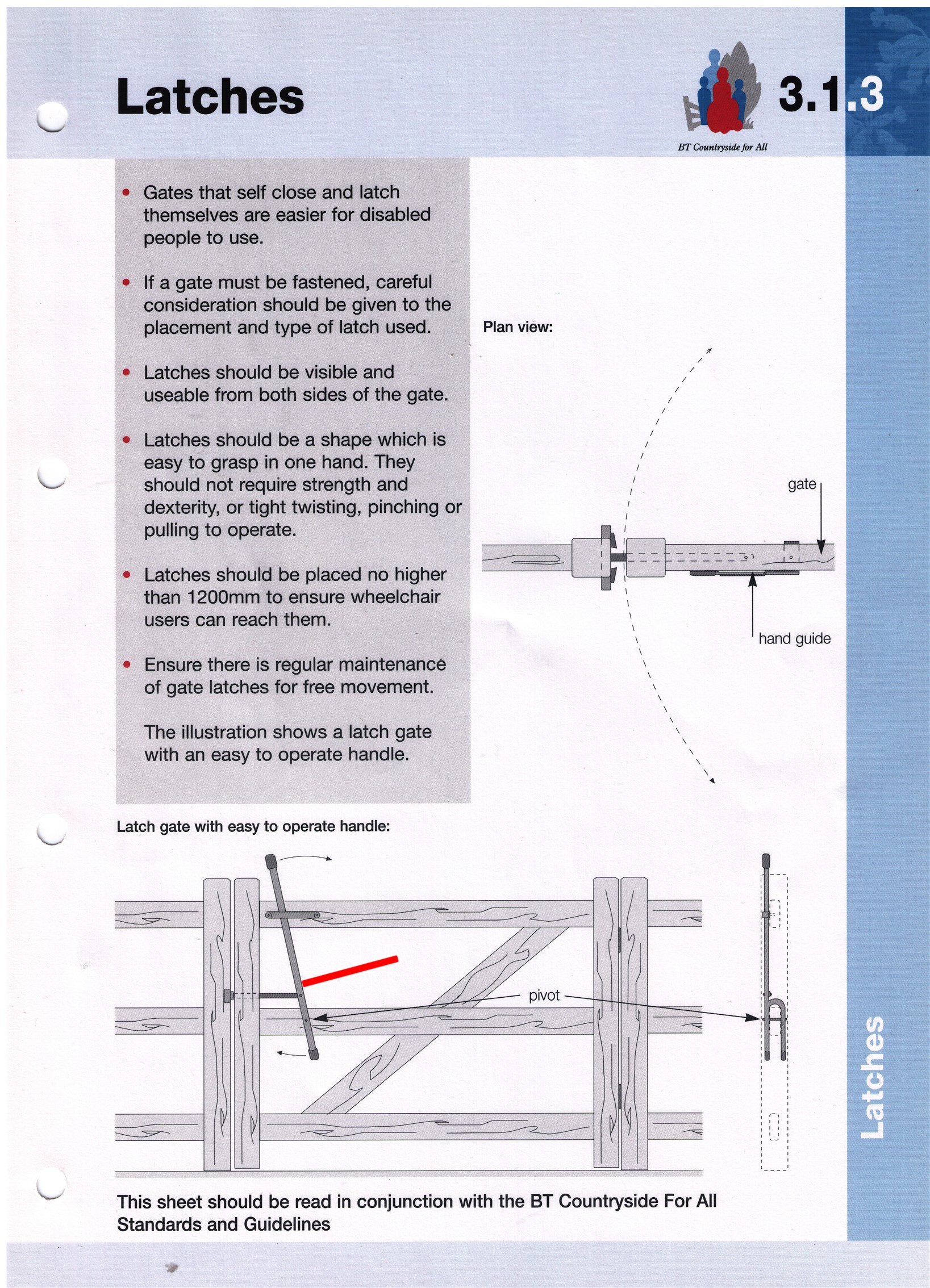 |
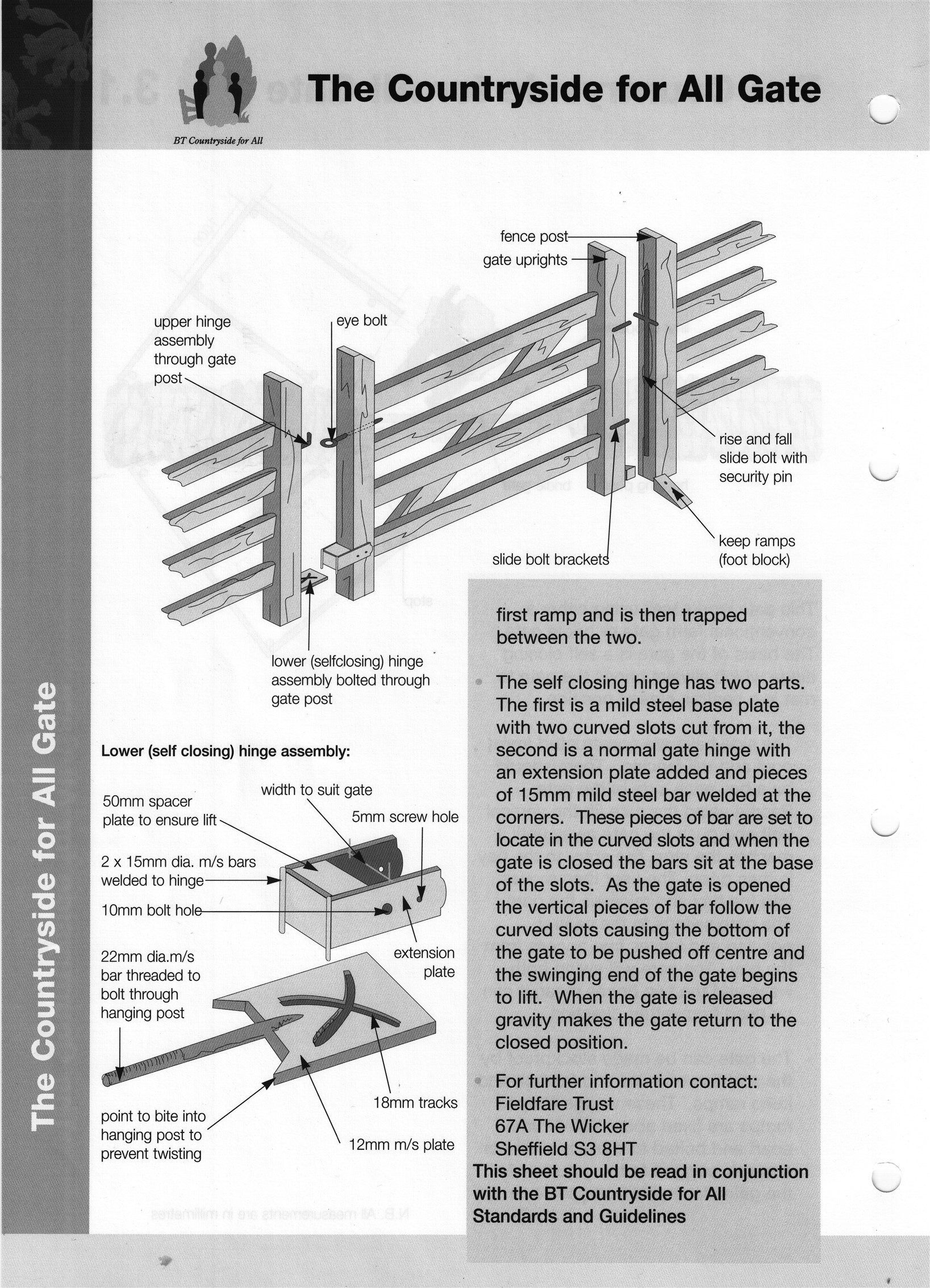
Pages from the Guide produced by Countryside for All (now the Sensory Trust) or possibly Dave Croft's Guide to Country Gates & Barriers (Most Likely). Their copyright is acknowledged.
Oops! Examples
Mirehouse Estate Cumbria
Old Sarum near Salisbury
Send us your photos and a description of the issues and we will add them to the list.
Good Practice Guides
An important issue for outdoor infrastructure is how to ensure that farmers' stock can be kept in their fields and away from routes. Thus it is inevitable that there will be some form of gate in many places. Happily, there are quite a number of sources for guides to good practice for access. We particularly liked the website of the Carmarthenshire Disabled Access Group which had a special Factsheets and Information page which has Guides for all sorts of situations. Sadly it no longer exists. Given our liking for countryside access, we were taken with Dave Croft's Guide to Country Gates and Barriers (Also no longer available). However there is Chester Cycle City version which is still available here: [https://www.chestercyclecity.org/wp-content/uploads/2022/04/Guide-to-Country-Gates-and-Barriers.pdf]
The best form of gate is simply a traditional gate hinged to swing both ways. This should be fitted with a lever operated mechanism of the type popular on horse rider trails. These are very easy for the less than able bodied user to open. The double hinged type are self closing and so should be stock proof.
Unfortunately many routes, especially footpaths have inherited kissing gates. These are apparently popular with farmers as they are proof against all but the smartest sheep. We believe that a simple two way gate as mentioned above is all that is needed, but not everybody agrees A second, less good, solution is to amend the gate in the kissing gate so that the basic gate is just too short to meet the posts of the compound. Onto this edge of the gate is hinged a further upright which, when held in position, prevents the gate from moving beyond the posts of the compound. A bolt can be used to hold this extra bar in the 'normal' closed position, but if the bolt is pulled back, the bar can be folded back and the gate used normally. If necessary for security, the bold can be retained by a RADAR padlock. (See diagram below)
Essentially, the kissing gate is relatively difficult mechanism to use because of all the maneuvering that is necessary when compared to a conventional gate.
Solutions
Perhaps the best solution is not to use a kissing gate, but instead to install a 'conventional' gate as mentioned above.
Wheelchair 'accessible' kissing gate solution
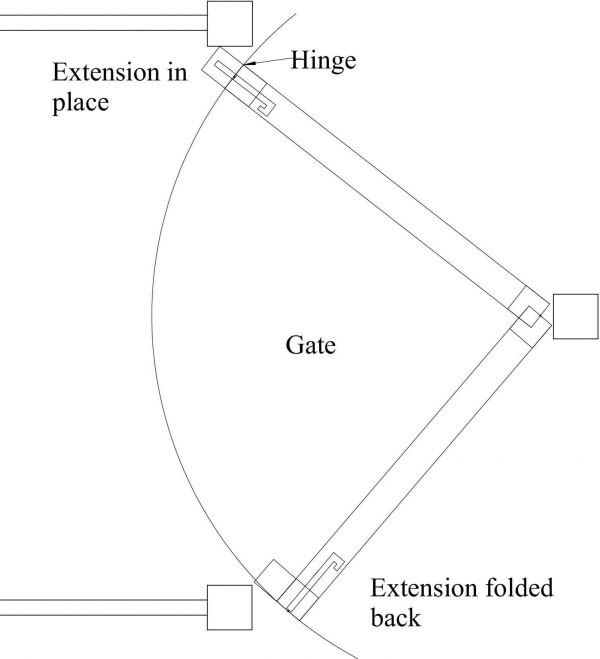
A second, less good, solution is to amend the gate in the kissing gate so that the basic gate is just too short to meet the posts of the compound. Onto this edge of the gate is hinged a further upright which, when held in position, prevents the gate from moving beyond the posts of the compound. A bolt can be used to hold this extra bar in the 'normal' closed position, but if the bolt is pulled back, the bar can be folded back and the gate used normally. If necessary for security, the bold can be retained by a RADAR padlock.
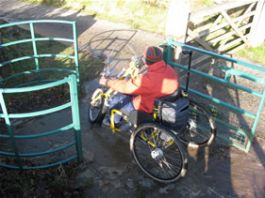
The good practice accessible kissing gate design is being rolled out by Cheshire East and some other Councils.
Some local authorities have taken the issue on board and are now doing away with gates on popular trails.
Mirehouse Estate - Cumbria
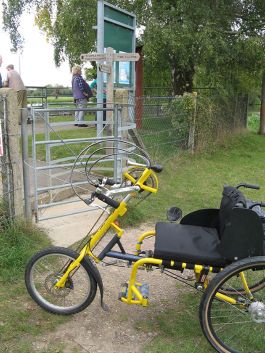
There is a nice circular 'accessible' walk round Mirehouse Estate, but the route is 'blocked' to the more independent visitor by three kissing gates. So why do these two constructions deserve an Ooops! award?
Looking at the picture it is clear that the compound of the kissing gate is barely large enough to contain the Easyrider and allow the gate position to be changed. Now this is on a country path that goes across fields, so a less than able bodied visitor is not going to be using a 'traditional', short wheelbase wheelchair with tiny front castors. S/he will be using something more suited to cross country action and that means a larger larger machine.
The second issue is that the easyrider is reversed into the space. Now, handcycles and suchlike do not have a reverse gear, so getting into or alternatively out of the gateway will require assistance, mitigating against the independent minded visitor.
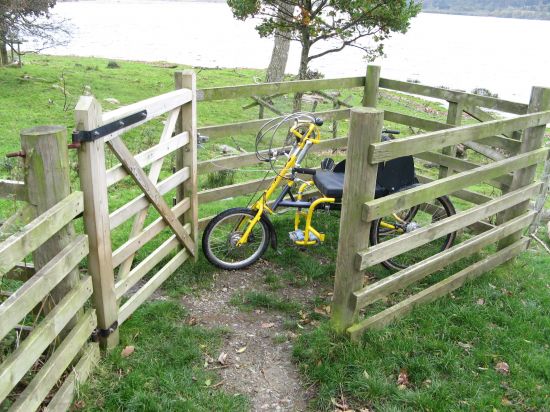 |
Note that the compound is barely large enough for the Easyrider.
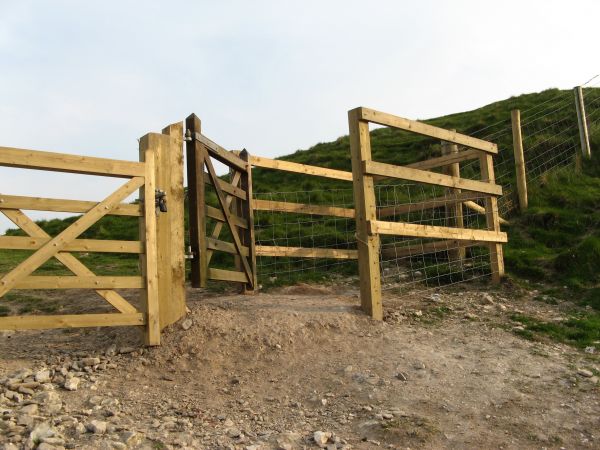
Picture Two shows the same issues at Old Sarum in Wiltshire but rather worse than at Mirehouse, The compound is smaller and would not contain the Easyrider. Additionally the entrance is effectively up a step up which would be nearly impossible to surmount. The barrier is installed at a site under the control of English Heritage who should know better. Cadw, the Welsh equivalent, seems to be much better in our experience and does not seem to install these gates.
 |
Our experience of these gates almost everywhere we meet them is quite poor access for a longer machine like the Easyrider. Essentially, the kissing gate is relatively difficult mechanism to use because of all the maneuvering that is necessary when compared to a conventional gate.