 |
|
Introduction
For those who have been forced to transition from being able bodied to less-than-able-bodied due to balance problems it does not mean that you have reached the end of your cycling career. It is possible to keep a favourite bike going and adapt it to your changed circumstances. The usual solution is to convert the bike from two wheels to three or more using stabilisers (see the Get Cycling page) or a trike conversion kit. It is the various options for the latter that are discussed in this article.
Conversion Kits
A bit of serious Internet searching will throw up a number of suppliers of conversion kits that bolt on to the bike. That search is unlikely to throw up the two UK based firms one of which does weld on conversion and one of which does both welded and bolted kits. Both are relatively small but specialised firms and details will be given below.
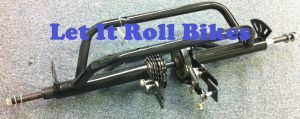
The typical kit on a Google search will come up in basically two versions; the single speed version and the 7 speed version. For anyone serious about cycling the 7 speed is the kit to consider as shown in the photo below
 |
There are many eBay suppliers almost all of whom are based in the USA (e.g. https://www.ebay.com/str/letitrollbikes) but it looks as if the product is the same one and probably sourced from China. However the kit does not appear on Alibaba nor is in available from a UK supplier as far as I can ascertain.
The kit comprises the two separate axle tubes that are connected together by a pair of bent tube stays. There is normally one axle to which the 7 speed freewheel block is attached and also a brake mechanism if fitted. The other wheel has bearing in the hub and is free to rotate independently of the axle. It is important to note that the kit is set up for cyclists in the US market who ride on the right hand side of the road. That means that the drive is to the right hand rear wheel. That would mostly not be a problem but in the UK it means that, because of road camber, the driven wheel is on the high side rather than the low side and may be more likely to spin if pushed too hard.
For kits that include a brake mechanism, this is applied to the left hand wheel. For these kits the brake type used is the very ancient strap brake method which is a poor performer and cannot be relied upon to give progressive braking. Other kits include no brake mechanism at all so that all the braking must rely on the front wheel brake.
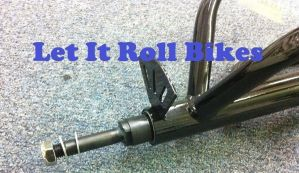
These kits are fitted by removing the bike rear wheel and attaching the kit with bolts to where the wheel used to be. Some variants of the kit have ‘torque’ arms that are looped over the frame legs to stop the kits rotating. Others, like the one in the photo above, just rely on securely bolting to the dropouts. None of these kits include bolt on stays from the outer end of the axle housing to the bike frame such as would be found on a welded conversion. A prominent omission from the advertisements for this type of kit is the wheel track distance.
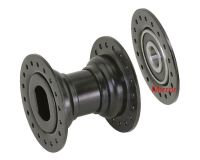 |
All the kits of this type use hollow centre wheel hubs which are usually sold as extra options. The vendors may offer whole built wheels or just the hubs. It should be noted that the drive is transferred to the wheel by an oval hole in the driven wheel hub into which an equivalent shaped boss on the axle fits. Thus the wheels are clearly left and right. Once in position the wheels are usually held in place by a washer and a single coarse thread nut. Whilst this works, it would be safer is the nut were a Nylock nut which is less likely to come adrift in use.
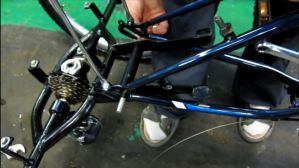
The method of assembly is to firstly remove the old rear wheel from bicycle. With that done the new wheels should be fitted to the axles of the kit making sure that the driving wheel is on the driven axle. Once the wheels are secured the kit can then be offered up to the bicycle drop outs and secured. For kits with no torque arms, it might be advisable to ensure that the kit is square to the bicycle frame by measuring the distance from the seat tube to (say) the inside of the wheel hubs. The distance should be identical on each side.
 |
With the kit in place the next step is to re-fit the cable to the gear changer. It is likely that a longer wire and outer cover will be required although the original changer can be re-used. Next a chain will have to be added. This might sensibly be a new chain and it will again be longer than the original two wheeler chain. Lastly, if the kit has the brake mechanism fitted that too should be connected up and will require a longer cable and more outer cover.
 |
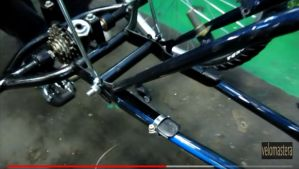
With that done the new trike is ready for checking and then testing.
 |
At this stage it is probably worth moving on to an alternative kit from a Spanish supplier, Rudas Electricas. The basic principles of the kit are similar to the widely available kit from the US. However, this kit looks to be much better designed.
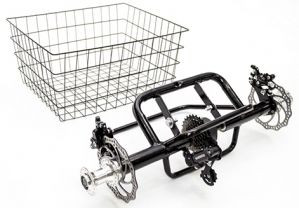 |
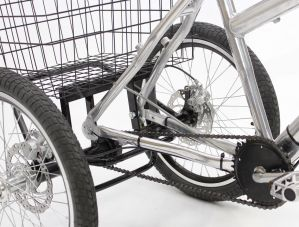
The first thing that stands out is that it comes with two disc brakes. Secondly, the seven speed gear includes a differential meaning that both wheels take the drive rather than just one. A further good point is that there seems to be a stay bar to the seat tube which suggests that the stresses on a bolt-on trike kit have been considered. The kit includes two hubs and wheels can be built for the buyer at extra cost.
The size of the kit is also made explicit in the publicity material and it is 74cm wide. This is approximately the width one would expect for an adult trike which means that the kit should work well for an adult bike. Adult original trikes tend to be around 70-75cm wide across the hubs with tandems at 80cm.
The final cherry on the cake is the addition of a wire basket that can be added to the rear of the trike, though whether this might be used by those who consider themselves ‘serious cyclists’ is a moot point.
As far as I can gather the kit is manufactured by the vendor and not bought in from the Far East.
 |
Finally it is important to mention the two UK based conversion possibilities. The first is Longstaff Cycles now incorporated in to Brian Rourke Cycle in Stoke on Trent. They are able to convert two wheel steel bikes to trikes by welding on their tricycle design. This is very strong with stays to the seat post and so on. However, it is not a ‘kit’ as such and is only suitable for steel frame bikes. Since this article is about kits no more will be said about this option.
The other UK based kit supplier was Trikit Conversions Ltd in Oxfordshire. Sadly the owner has now retired and nobody has taken up his business. However, there may be versions of this kit available on second hand bike/trikes. This company, like Longstaffs had a long history of providing high quality ‘traditional’ single and tandem trikes. The kit picks up their axle technology and makes it available for conversion of almost any adult bike. The axles of the kit are 75cm across the hubs giving a track of about 70cm. The kit for tandems is 85cm across the hub. That means that a good stable single or tandem conversion possible with the right size of kit. The method of fitting is similar to that mentioned earlier in this article except that the axle tubes have lugs for the diagonal stays. These bolt to the end of the axle and attach to a collar on the seat post replicating the stays found on a welded conversion.
This kit came with either no brakes or fittings for disc brakes. In addition the drive could optionally include a differential so that both wheels are driven. Hubs were provided and the purchaser could either get their wheels built by Trikit of have them built elsewhere.
Costs
It is always difficult to specify exactly how much it would cost to make a trike conversion since there are usually lots of options that can be ignored or added. Some idea can be provided of the typical component prices as is shown in the table below:
eBay Sellers in the US
Let it Roll Bikes trike conversion 7 speed unit £177
Shipping £ 93
VAT £ 54
Total £324
Hollow Hubs (Left & Right) £ 74
Shipping £ 20
Total £ 94
Wheel building plus rims & spokes £100
Grand Total £518
Rudas Electricas (Spain)
https://ruedaselectricas.com/producto/kit-conversion-triciclo-con-marchas/
Full kit with wheels but not disc calipers £205
Shipping (Guesstimate) £100
Total £305
Conclusions
This little piece of research has established that it is perfectly possible to convert one’s existing bicycle to a rear wheel trike. It is the sort of task that anyone with DIY skills could do or your local bike shop could do for you. The difficult part is to decide upon the choice of technology.
My own view is that the US sourced kits should probably be avoided, especially if one has to pay international shipping charges. My second reason relates to the technology. Of the kits examined that particular design is the least sophisticated and generally offers poor or no brakes. For the less than able bodied my feeling is that good brakes are essential.
Rudas Electricas kit looks like a clear winner on price, however much the Brexit Bureaucracy Bungle adds to shipping costs. Technologically it is good for having disc brakes and coming with hubs/wheels matched in the kit. The apparent stay does not appear, from the photos, to come from the ends of the axles. However, the ends of the axles do have weld on brackets for (I think) mud guards which could easily be utilised to add DIY stays to the seat tube. That would give quite a strong and rigid result but only for a single trike as it is not really wide enough for a tandem.
The Trykit Conversions kit were clearly the best of the bunch from an engineering viewpoint. For those who are avid cyclists and still want to do serious miles it would have seemed the sensible solution. Perhaps It would also have been the safest for those wishing to convert a tandem. If anyone is keen on that standard of conversion it is probably worth contacting Brian Rourke Cycle in Stoke on Trent. For European readers it looks as if the Rudas Electricas kit is the best bet.
Sources
Letitroll Bike Shop (eBay Shop)
Rudas Electricas (Website)
Longstaff Cycles (Website)
(c) 2022 April - Cycling Otherwise