 |
 |
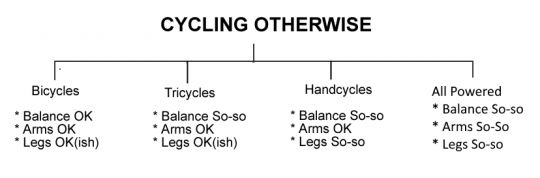 |
However, only you can know the impact of your condition on your physical abilities, so what we will try to do here is make some suggestions. Crude as our analysis may be, we hope it will point out a possible route for your investigations to follow.
Our three crude criteria are “Balance”, “Arms” and “Legs” and their potential conditions will be OK or So-so. We know it is crude, but it has the advantage of being simple!
Bicycles
Provided you do not have a problem with balance, then we would say “Don’t give up on your bike!” If the main problem is with your legs, you can keep cycling. We would envisage two main issues; leg weakness and loss of the use of one leg. In the case of weakness, you can keep cycling with the aid of battery assistance. This can either be as a retro-fit kit for your existing bike, or by acquiring a specific electric bike. There are two types of control available, twist grip and pedal assist. The former is like the throttle control on a motor bike and will allow you to power home on the battery, even if your legs have given out. The pedal assist mechanism requires you to keep pedalling and provides power in proportion to the effort you put into pedal pushing. That is not so good if your legs might give out on you, but works well if you can probably maintain some input. If you have effectively lost the use of one leg, one solution lies in seeking adaptations to your bike from specialists such as Longstaff Cycles or Mission Cycles. They have a great deal of experience with disabled cycling and can do such things as a "free-wheel" crank for the bad leg. If a knee is the source of the problem, they can fit different length cranks so that the bad knee does not need to bend so far as the good knee. Another solution is to fit a crank shortening device (eg. https://www.sjscycles.co.uk) or possibly have your existing crank shortened by re-drilling and cutting off the excess (This can be done by many bike shops (e.g. Tarty Bikes)
Adapting a bike to suit one's particular problems is well illustrated in the Breath of Fresh Air Blog. Mary's blog on adapting the Tandem is excellent: http://breathoffreshairblogdotcom.wordpress.com/the-tandem-and-minor-modifications/
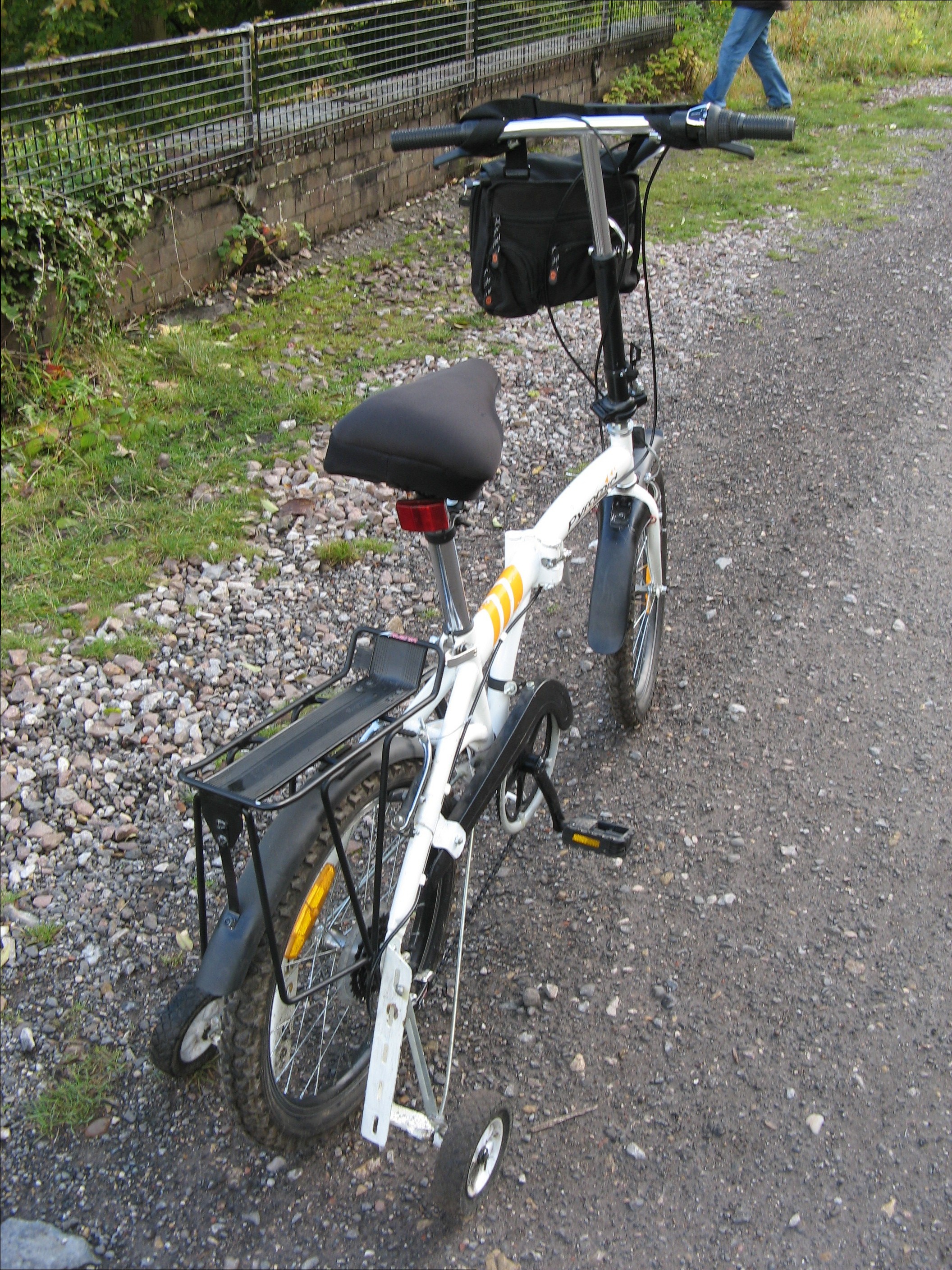
If you have slight balance problems, have you thought of adding stabilisers to your existing bike? We met a retired engineer (Ex Concord development team) who had knocked up the adaptation in the photo for a folding bike. (See right) He and his lady had one each and they fitted neatly onto the back seat of his car. We met another couple who have bought the Canadian version from EZ which are sprung to allow one to bank the cycle in turns. Remap is a group of retired engineers who like to organise adaptations for disabled riders. See Pauline's story to find out more about this service.
Tricycles
If your balance has become a problem, then a trike is probably the solution. Trikes are rather different to ride than a two wheeled bike in that you have to steer round corners and cannot do banked turns as on a two wheeled machine. Until that process becomes automatic, you will find that the trike will continually want to drift down the camber to the edge of the road. The good news is that this makes trikes much less likely to be stolen – the potential thief is not likely to make a successful getaway!
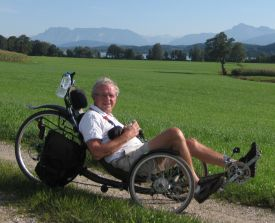
Another interesting variant that is well worth considering is the Recumbent Trike. Click here for an in depth analysis of these machines by Peter Bayley.
Once you have learned how to drive one, the other benefits of a trike soon become apparent. A trike just sits there while you load up your stuff and climb on. You can get comfortable, check the position of your mirror, tighten your toe straps, etc. all before you begin to roll. Similarly, at traffic lights or stop lines you do not need to put a foot down on the road, you just come to a stop. Finally at journey’s end when you stop, the trike sits nice and steady while you climb off. There is none of the need to find somewhere to prop up your bike while you get your stuff offloaded. So, a trike is very civilised. If balance and legs are the problem, then trikes can be powered just the same as two wheeled bikes. One can also get tandem trikes that are more sociable and have a longer range if your second rider is able-bodied.
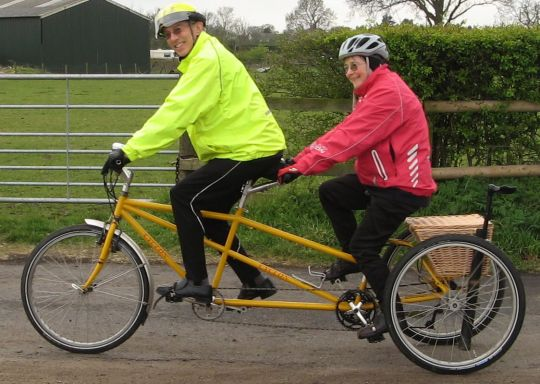
A modified Longstaff tandem. Note the lowered Stoker's cross bar
The other issue is transportation to other locations. A 'normal' bike rack will probably not do for a trike unless the machine is partially dismantled. The easiest solution is probably a small trailer of the type sold by Halfords and similar vendors. Alternatively one can have a custom trailer made by a specialist trailer firm. Ours came from Towtal Ltd (http://www.towtal.co.uk/), but there are many such specialists to be found.
Handcycles
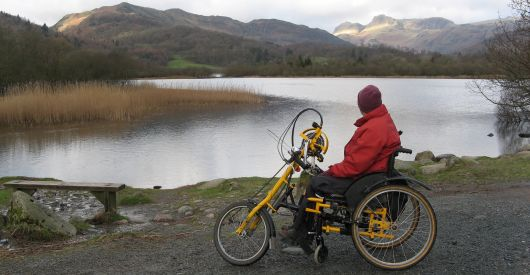
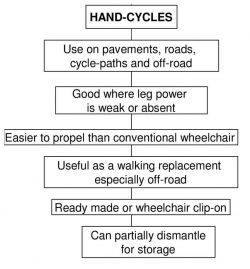
If walking and leg strength are issues, but your arms are OK, then do have a look at the world of handcycles. These machines are usually tricycles, but the power to drive them is provided by hand driven rather than leg driven cranks. As both arms work together when cranking, the power input is actually derived from both arm muscles and from trunk muscles. This means that you may have more power than you imagine.
The choice of machines is wide, including some with power assist, some based upon wheel chair conversions, not to mention the out and out racing machines used for competition. The uses to which they can be put are pretty wide too. They can be used as a bicycle replacement, or can be used more as a walking replacement. They certainly outperform conventional wheel chairs in the majority of circumstances where the going surface is not a well polished floor.
Finding a Suitable Machine
For tricycles a low step over for easier mounting is important. Electric assistance could well be beneficial. Tricycles are bulky machines so a degree of folding could be valuable. Some of these characteristics are available on various models from Mission Cycles (missioncycles.co.uk). Two of these are the Space Genie Folding Trike (£1,555) and the E-mission Electric trike (£2,065). The most compact folding model with optional electric assist (R34) is from Di Blasi (www.di-blasi.com). Inevitably more expensive (£2,989) but is available through Mission. (Prices at 31/8/2026)
Handcycles come in two main forms – as a complete machine, but also as a ‘clip on’ third wheel with gears for attachment to a rigid wheelchair. There are a number of British firms who manufacture their own handcycles, or supply from elsewhere. Bromakin (bromakin.co.uk) is based in Leicester. Davinci (davincimobility.co.uk) is at Liverpool. Draft wheelchairs (draftwheelchairs.com) is at Cambridge and Team Hybrid (teamhybrid.co.uk) are in Hampshire.
For one piece handcycles Draft wheelchairs currently offer the one piece Top End’s Excelerator at £4,355 and Team Hybrid’s ‘clip on’ Coyote S7 at £2,395. Electric assist can extend possibilities and is offered in various models. The Speedy Versatio F, available from Bromakin, is currently 'priceless' (31/8/2026) but looks well specified but probably expensive when the price eventually arrives.
With a partner tandems have many advantages. Cycling together is fun, and you can go further and faster. Beyond the conventional two wheeler a tandem trike provides extra stability. Ours is a conversion from Longstaff Cycles and they also provide more expensive custom builds (longstaffcycles.com). The Pino is an interesting two wheeled tandem from German firm Hase (hasebikes.com). The rear rider controls things and sits higher than the front recumbent rider who could be provided with hand cranks if foot cranking is a problem. A full tricycle with hand cranks for the rear rider is available from the Canadian firm Varna (varnahandcycles.com)
And last, but by no means least, there is Tim Morgan’s fantastic Mountain Trike (mountaintrike.co.uk). This is a mountain biker’s machine in its origins, but actually with slightly different fittings, it makes a superb urban machine too. Check out the website, go for a demonstration or rent one for a few days. Using it beats reading about it!
All powered - Don't give up!
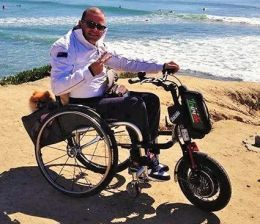
We also appreciate that for some people with some conditions bicycles, trikes and handcycles are not suitable because they have neither balance nor arm and leg strength. We would say do not give up. If you already have a wheel chair then getting out into the country is still possible with a powered 'front end' or 'tractor' add on. The technology is basically like a powered handcycle with handlebars rather than cranks. It will not give you aerobic exercise but it will get you out there into the countryside.
This type of machine is used by the author Thea Lewis whose guide book and e-book for Kindle Explore the Peak District by bicycle offers 50 routes that could be easily completed by such a combination. The paper version is available here: Amazon (See our Review here)
Given the limitations of space in this section, we would suggest that you follow our Power Trike link to a much more detailed discussion of these machines. The section also includes a very informative user experience piece from Thea Lewis.
Details of the main suppliers are given in the margins of that section.
Start Here!
Here at Cycling Otherwise, we feel that it should be possible for most people to continue or even start some form of cycling, despite becoming disabled or developing a chronic illness.
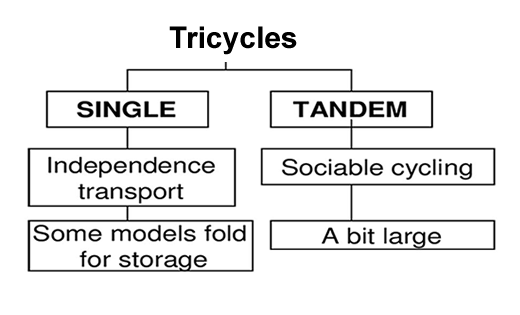
The main downside for tricycles is the same factor that gives them their stability. Having two wheels at the back requires much more space for storage when the machine is not in use. They tend to be about the same width as wheelchairs, but most folk keep their wheelchairs indoors. Tricycles tend to better kept in the garage if such a space exists, particularly if you are the sort of person that likes to make full use of the machine and get the wheels dirty.
Some useful links
1 Trikes
Hase Cycles - http://www.hasebikes.com
Mission Cycles - http://www.missioncycles.co.uk
Longstaff Cycles - http://www.longstaffcycles.com
Tricycle sales - https://buytricycle.com/
Jorvik Trikes - https://jorviktricycles.com/tricycles
Adult Stabilisers
Mission Cycles - https://missioncycles.co.uk/products/adult-stabilisers
eBay - https://www.ebay.co.uk/itm/264692419217
Amazon - https://www.amazon.co.uk/
2 Handcycles
Da Vinci Wheelchairs - http://www.davincimobility.co.uk
Draft Wheelchairs - http://www.draftwheelchairs.com
Team Hybrid - http://www.teamhybrid.co.uk
Bromakin - http://www.bromakin.co.uk
Varna Handcycles - http://www.varnahandcycles.com
3 Mountain Trike
Mountain/Urban Trike - http://www.mountaintrike.com
Not quite 'off the shelf'...?
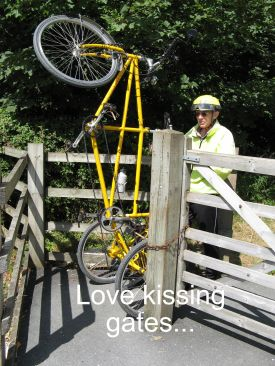
Quite a lot of people's needs can be met by 'standard' products that incorporate a range of adjustment for particular issues. For example seat height, reach to bars, crank length and so on. However, in some circumstances what may be needed is something non-standard and innovative. Happily, there is a way to get such solutions. Read the article by Pauline Udell to see how it might work for you.
4 Power Trikes...
 Power Trike image pinched from John Preston Healthcare (John Preston). Other brands of machine are now widely available eg. Batec Mobility.