 |
 |
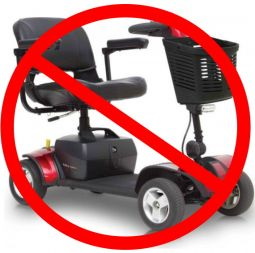
The 'Mobility' scooter. Readily available but often the wrong choice.
The principal UK players in the e-trike market would appear to be:
Batec - https://batec-mobility.com/en/
DaVinci - https://www.davincimobility.com/handcycle-davinci/
Klaxon - https://klaxonmobility.com/products/
Triride - https://www.trirideitalia.com/en-gb/#
Viper - https://teamhybrid.co.uk/product-category/handcycles/full-electric-powered-handcycles/
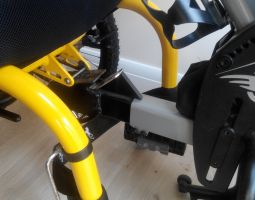
Figure 1 - The Batec Connector
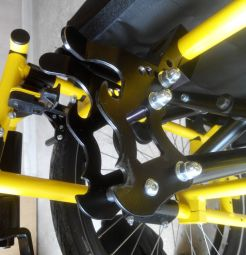
Figure 2 - DaVinci chair fitting
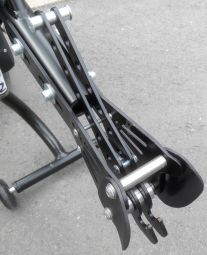
Figure 3 - DaVinci tractor fitting
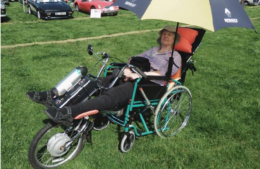
Figure 4 - My PDQ with original 150W hub and additional Li-ion bottle. I ‘sit up’ when manoeuvring and recline as necessary. With total battery weight carried high and in front of the trike’s 75” (190cm) length it is a ‘toppling’ force.
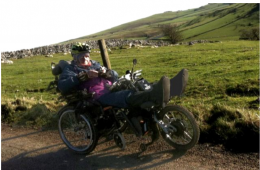
Figure 5 - My new Batec/ wheelchair combo shortly after its acquisition. The Batec stand has not yet been shortened (its wheels can be seen close to the track) and though the wheelchair has mudguards, I have not yet fitted one to the front wheel. Despite the comfortable reclined position the combined length of trike and add-on is just over 60” (152cm). In the long shadows of a winter’s day I am wearing a
balaclava, sheepskin over-boots and several layers of clothing!
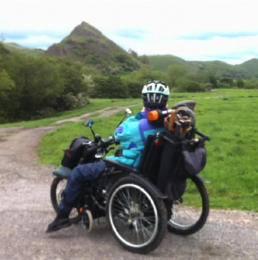
Figure 6 - With the adjustable wheelbase as short as is comfortable and with spare batteries carried below the level of the seat, even when laden with every kind of gear useful for trekking my wheelchair/Batec combo is unlikely to ‘topple.’ It is now as close as I can make it to being perfect for my needs. The orange lights behind my head (another DIY project) can either flash together as a warning light or be used as turning indicators. Other useful objects carried in the bags at the rear are umbrellas and a folding seat, kit that has enabled my companion and I to comfortably sit out bad weather.
Many people for whom walking has become difficult or even impossible are drawn towards the purchase of a mobility scooter, not least by their ready availability from stores in every high street. This is unfortunate as the mobility scooter with its small wheels usually provides the user with a terrible ride and often a poorly designed seat. Going any distance on such a machine can become a form of torture which rather defeats the object of getting ‘mobility’ equipment. The commonest type are also of little use for anybody seeking to get into the countryside as their small wheels are useless on unmade tracks.
By comparison even the cheapest wheelchair, if chosen with care, can provide the rider with a comfortable seating position and ride. Moving up the price range allows the user to get adjustable backrests, suspension and so on all of which make for a better riding experience. Of course, the only down side of the wheel chair is that it has small castors at the front which seem to catch every obstacle and, where the user does not have much upper body strength, cannot be easily be propelled by the hand rims. For such people the solution is probably the e-trike wheelchair add-on. This is basically a powered front wheel that changes the wheel chair into a tricycle (or quincyle for sharp eyed little girls/boys) and lifts the castors off the ground. Thus the wheelchair and add on ‘tractor unit’ provides improved mobility, greater comfort, faster speed but is just as easy to use as the ubiquitous mobility scooter.
From the standpoint of government rulings, rather than being likened to a mobility scooter and classified as an ‘invalid carriage‘, regulations for using such a trike on public roads are more closely aligned with 'electrically assisted pedal cycles.' A mobility scooter is categorised as an ‘invalid carriage’ with ‘Class 2’ rating and is thus restricted to pavements and a speed of 4mph. Only ‘Class 3’ mobility scooters are allowed on roads and they have to be registered with the DVLA and can travel no faster than 8mph. Happily, the e-trike wheelchair falls into a different category which is designed for electrically assisted bicycles.
'Electrically assisted pedal cycles' (or trikes) and their power unit, a hub or crank-drive, are restricted to a maximum output of 250 watts and power assisted speed of 15.5mph. If capable of greater speed they have to be type approved and may need to be registered. Electrically assisted pedal cycles cannot be used on a public road by anyone under the age of 14. A ‘twist and go’ control (desirable for anyone with minimal leg power) is permissible for people with disabilities, but not for the general user. In the latter case type approval and registration are technically required. However, UK rules on electric bikes are messy and were to be tidied up under EU regulations, but will probably languish under Brexit. For those who wish to know more see: [https://thiis.co.uk/powered-handbike-attachments-a-regulatory-grey-area/]
Wheelchair add-on motors sold in the UK have ‘approved’ classification, can use ‘twist and go’ controls and do not need to be registered. They usually are provided with variable speed settings. One will be a 4mph setting for use on a pavement when accompanying a pedestrian. The other setting is likely to correspond to the 15.5mph maximum powered speed of e-bikes and thus the machine can be used on public roads. The twist grip power control is uncontentious for these machines as they are deemed to be for disabled users. Some Far East trikes with more powerful motors that can give higher speed are available online, but the greater speed should (strictly) only be used when on private land.
One of the principal issues that the potential buyer of an e-trike should consider is the ease with which the tractor unit and the wheel chair connect. Bearing in mind that such buyers will not be in first class physical condition it is worth stressing that to avoid injury the connection process should not involve the user doing any lifting while seated in the chair. This writer’s spouse suffered a damaged vertebra and serious muscle strain from attempting to connect a machine by lifting at a vendor demonstration. It had not been appreciated at that time that her osteoporosis was so widespread, but that was a quite unnecessary injury which has continued to cause her problems.
The ‘typical’ connection probably does not exist but it is worth considering in detail how two of the key players in the market solve the issue. Both the DaVinci machine and the Batec machine incorporate a stand so that the tractor unit stands up on its own. The stand in both cases includes castors and it is possible, on smooth surfaces, to wheel them about. The Batec stand doubles as a mudguard whereas the DaVinci stand is a simple T shaped tube. The base of the stand is the part of the system that determines the ground clearance of the fully assembled trike.
Both the Batec and the DaVinci systems are based around two horizontal bars, either mounted on the connection tube of the tractor unit or on the chair. In both cases connection begins by engaging the upper bar into hooks and then tipping the chair and tractor to bring the second bar up to connect and lock. This tips the tractor unit forward and lifts the stand off the ground.
Figure 1 shows the Batec system with the tractor bar and its ‘ramped’ hook system. It can be seen that as the tractor is pulled on its wheels towards the chair, the ramp will bear on the cross bar on the chair and gently tip the tractor backwards. As the bar engages with the hook, the tractor will ‘un-tip’ indicating successful initial connection to the user.
It should be obvious that to get this far will have caused the user very little effort since the tractor unit rolls easily on its wheels. However, to make the final connection and lift the stand off the ground requires 15kg* of effort. The Batec system does not need the user to put in that amount of effort because it is set up so that the wheelchair is easy to tip backwards when the user is in it. This is a ‘normal’ setting for most wheelchairs to enable pushers to tip the chair and get the castors over obstacles. Thus in the Batec system, once the first connection is made, all the user has to do is to lean backwards. This will ‘overbalance’ the chair with the weight of the user and the chair providing the force to lift the front and overcome the spring on the second clip that will make connection with an audible click. At that point the chair can tip back no further and the tractor unit’s castors will be off the ground. The trike will then be ready to roll.
Figures 2 and 3 show the DaVinci system in which there are two sets of hooks on the chair and two cross bars on the tractor extension. The method of connection is similar, but requires the two parts to be carefully set up. The top cross bar on the tractor extension must be at the same height as the top hooks on the chair bracket.
If the bar is higher than the hooks connection will be more difficult because the user has to tip the tractor so that it connects and then, holding it in position, lean back in the chair to tip it and bring the second bar in connection with the lower hooks. The risk is that the tractor will simply run away if the user pushes back without the hooks engaged.
If the bar is lower than the hooks the user is faced with the need to lean forward and lift and pull the tractor extension bar to engage the hooks. That is not an easy task for those with little strength or with weak backs. The cross bars at that height also make disconnecting the machine difficult as lifting is required to remove the cross bar from the hooks.
With the correct heights set up the user is still faced with a small lift (8 kg*), but may be able to avoid that by ‘bumping’ the tractor extension into position. Disconnecting the machine also necessitates a small lift to unhook the cross bar. Making the final connection is also by backwards lean and that requires 10kg* most of which should be user weight.
Both machines need careful attention to setting up and aligning the chair and tractor connectors. Of the two, we feel that the Batec appears to be the machine best suited to those needing a minimal force connection. The DaVinci is probably best for those with stronger upper bodies. We would suggest that potential buyers ask very searching questions about the way the proposed machine connects and the degree of force/lifting required to achieve that end.
*The data mentioned above comes from tests with two comparable hand cycle combinations that use the same connection technology as the firms' tractor units. It should be borne in mind that the power only machines are heavier. Adjusting the connectors to suit particular riders can also alter push back pressure and ground clearance.
Battery-powered trikes: a user’s experience with wheelchair add-ons.
By Thea Lewis
Every wheelchair add-on motor differs from another and for my own purpose it was a process of trial and error that led me to find what was best for me. The most important deciding factor is how and where you intend to use the add-on unit.
To begin with I just wanted to get into the great outdoors. Living just a few miles from the Peak District’s network of walking/cycle trails, I was itching to be ‘out there’ in the fine countryside. A power-chair that had released me from the confines of a house was totally unsuitable and although a hand-cycle was a possibility, I’d already declined the offer of one being ‘sold-on.’ Its owner found he had insufficient strength to propel it any distance and it was pointless for me to even try one since my own upper-body power was weaker than his.
But an ‘add-on’ battery-powered one could be the perfect solution. Could I manage such a vehicle and could I afford to spend a large sum of money on what for me at that time would have been an experiment?
To cut a long story short, I found an advert for an original Da Vinci PDQ ‘Power Trike’ listed on Gumtree that with an asking price of just £75 I thought ‘worth a punt.’ It was in Scotland and for ‘collection only,’ but for a little extra cost I managed to arrange its delivery. Within a few weeks the much battered Power-Trike was mine.
Sold ‘for refurbishment’ and warned that it hadn’t been used for years and had a dead battery, would I be up to assembling the jumble of metal bars, wheel and handlebars that had been delivered? I found the necessary instructions on YouTube, although I needed considerable help to unlock some pretty rust-welded bolts before I could start.
As one of the first of its type, the Power-Trike will never win prizes for ease of attachment or design. The clamps fitting it to a wheelchair are somewhat crude and with my minimal strength, once it had been linked to the wheelchair it was impossible for me to remove it: no problem if wheelchair and drive wheel were to stay together, but a very real difficulty if the two were to be separated for storage or transport.
The most generous compliment I can award this early model of wheelchair-trike is that ‘it worked.’ To my great surprise, as soon as it was fitted with new lead-acid batteries I was mobile. This says a great deal about the reliability of this early-build unit.
I was grinning from ear to ear on return from my first test ride, thrilled by a smooth ride and a ‘wind-in-the-hair’ free-wheel back to base. But from this early beginning I had a lot to learn: first that the original e-hub had only minimal power, and also that its 36 volt battery made from 3 x 7Ah 12volt lead-acid batteries in series was both very heavy and didn’t provide more than a few miles’ range. But it was my first, wonderful taste of freedom since becoming disabled. During my teens and student days I had cycled through much of Britain and parts of Europe, satisfying a yen for exploration at a time when funds were scarce. But I had also discovered that the very act of cycling touched something in my soul: the sense of ‘open air,’ and of freedom. Now, some 50 years on, riding my e-trike is equally uplifting.
My desire to give the PDQ more range led me first to add a little extra power with a lighter weight lithium battery (see the photo with ‘bottle battery’ mounted over the lead-acid battery case). With two batteries, when the lead-acid was exhausted I could switch to the other, thus doubling the distance I could travel. I cannot recommend lead-acid as a power source, I now use lithium batteries exclusively (preferring LiFePO 4, over Li-ion), but I’m a great advocate of a two battery system: if one battery should fail there is always a spare.
With my new found freedom it was not long before I developed a yearning to get higher and further into the Peak District hills, so in addition to increasing available battery, a more powerful motor was called for. Greater power, I thought, would improve hill-climbing ability and relieve my accompanying sister from the chore of giving me the occasional push.
Here I experienced my biggest ‘BUT’ when I discovered that increasing the wattage of any motor is NOT the answer to improved hill climbing. The original PDQ motor (a brushed 150W one) was replaced with a brushless e-bike hub of 500W and though it significantly increased the trike’s speed, at the very first steep hill the new motor simply stalled. Why did it not have enough ‘oomph’ to help on the hills?
With information from that great source, the internet, I was taken to webpages discussing e-bike hill-climbing ability and from such webpages I learned that the simple measurement of power expressed in watts gives no indication of hill-climbing potential. Instead, a measurement of torque is needed.
No advertisement for add-on trike or e-bike gives much information about hub type or torque, but from various published hill-climbing trials I discovered there are different types of hub. Those known as ‘direct drive’ are where the outer rotating shell carries the magnets and the stator is the central shaft: a simple, robust system, this needs a big and heavy hub to produce enough torque for hill climbing. The type of hub winning the hill-climbing trials was very different, a somewhat more complex one with planetary gears driving the wheel through cogs in the hub’s outer shell. This geared design means the motor itself runs at an efficient high speed whilst its outer shell/wheel turns more slowly, thus it works a little like bicycle gears do and is the perfect way to give optimum torque.
I had not known of these different designs when fitting the first direct drive e-hub. In fact it had performed as I now would expect – my trike went faster, but the motor hadn’t enough torque. I cannot claim to understand the issue of e-hub torque – far from it – I only learned how complex the issue is. But as a workable rule it seems that a hub with low RPM (rev/min) will produce greater torque than one with high RPM. As a corollary, when it comes to hill climbing, a smaller wheel will have an advantage over a larger one, although here I must add a caution: small wheels are at great disadvantage when riding on a loose or rough surface.
Other differences between the two types of hub are that the direct drive can generate power when braking – the so-called ‘regen’ facility. Until recently this wasn’t possible with a geared hub, but Grin Technology has recently introduced a geared ‘GMAC’ hub which can feed power back into the battery. The big minus for me is that this ‘regen’ geared hub means loss of freewheel capability and for my purposes I think the facility to free-wheel downhill is more important.
For anyone interested in modifying/building an e-bike/trike and interested in an e-hub’s torque measurement a simulator can be found on the ‘Grin Technologies’ website.
https://ebikes.ca/tools/simulator.html
Also, if anyone is thinking of putting together a similar wheelchair e-trike without ‘breaking the bank’ PDQ frames and parts can still be found online. My background knowledge of bicycles came in handy when making the modifications, but in general, the fitting of an e-bike kit needs only a modicum of DIY skill.
Before continuing to tell of my next improvements I feel I should point out that I have yet to meet a salesman who has much understanding of the equipment they sell. Try enquiring whether the e-hub used in a particular model is geared or direct drive and you are likely to be answered with information about its wattage or battery capacity. Ask about what the motor looks like inside (the planetary gears are a give-away) and you will probably be told that opening the motor nullifies its guarantee.
I was well satisfied once I had changed the direct drive hub for a geared one (low speed, 200rpm). In fact I was smiling from ear to ear on return from the first trial run as I had soared up a local hill once used in early motoring days for hill-climbing trials (around 16% gradient).
Happy with the better performance of my re-engined PDQ, what followed were some wonderful years riding around the Peak District. It was just a great shame that I was never going to be happy with the PDQ design.
Apart from difficulty when removing the drive wheel, the unit also needed better stability. I’d had a couple of accidental ‘topples’ caused by the weight and height of batteries over the front wheel. Repositioning them underneath the seat would significantly improve stability (all manufacturers please note!). In addition, with two Shimano cantilever brakes mounted about 3 inches apart and applied to the front wheel the assembled trike had very poor braking. On long downhill stretches the brakes were hard on my hands and in wet weather they were potentially dangerous. Fitting a disc brake was not a DIY option as specialised welding equipment would be needed to fix a bracket on the alloy frame. When I asked the agent (DaVinci) how much this might cost, the price quoted was rather more than I was prepared to pay (quite apart from the fact that I would be without my precious trike whilst the work was done.). But in addition to such desirable changes, a more robust wheelchair was needed. The jointed tubing of my budget folding wheelchair was riveted rather than welded and at times when bumping downhill on rough ground I had sometimes feared it might fall apart!
A visit to a local mobility show was called for and whilst there I made a decision. I would invest in both a new wheelchair and a new add-on e-wheel. My choice of add-on wheel was a Batec: I was sold on its ease of mounting. However, a suitable wheelchair that would recline and could fold for ease of storage was more difficult to source. (Why do so many sit the patient bolt upright?) I finally settled for an Invacare Action bought from a local mobility shop. It had been on ‘special offer’ and although its ability to recline wasn’t sufficient for my needs I thought it might be easily modified.
In the event my choice was not perfect. As is advertised, the Batec stand makes the unit easy to attach and remove, and for most purposes it probably doesn’t matter that it is a low to the ground. In theory, the small wheels fitted to its stand should allow it to run easily over obstacles, but for the trails and rough ground I regularly use its height above ground was not sufficient. Apart from the occasional rattle over stones, I found that when riding in woodland the stand would collect twigs and even, on one occasion, I found I was dragging a fallen branch. At other times the stand would catch at a pavement edge, stopping the wheelchair dead and with the drive wheel spinning in mid-air. Then after one major incident when the wheels of the stand became buried in mud I decided ‘something’ had to be done. I had been riding up an embankment and the stand wheels had buried so that I could move neither backwards nor forwards; the front wheel simply spun and buried me further. When bodily removed from the wheelchair, its stand and drive unit was dug out and though now able to continue riding I was covered in mud from top to toe!
The manufacturer refused to consider the problem, but I was gratified to see that a more recent ‘Scrambler’ version of the Batec has a spring-loaded stand. I believe this modification ought to be standard on all models. Soon after the mud-burying incident I shortened the stand (by 6”, 150cm) and fitted it with an attachment that after drive wheel and chair are connected can be lifted clear of the ground. To help others I have a YouTube clip, ‘Batec Stand for Off-Roading.’ [Sorry, No longer available] A few people have been in touch for more detail.
Probably because of its manufacture in sunny Spain, another problem with the Batec is poor weather protection. A regular bicycle mudguard cannot be fitted because there is insufficient space between the front forks and mountain-bike tyre. Until I managed to fabricate a fibreglass mudguard, if riding in bad weather I would often return home spattered with mud.
I’m happy to report that with altered recline and additional padding the Invacare Action proved a suitable partner for the Batec. Now sufficiently comfortable for an occasional post-lunch snooze, the most rewarding improvement I made was a switch to pneumatic ‘mountain bike’ tyres. How I ever managed to cover so many miles with my earlier wheelchair’s solid tyres is beyond me.
I am now thoroughly satisfied with the performance and comfort of my trike and have no thoughts of changing it, but I occasionally ‘web surf’ to see what new products might be available. Prior to lockdown I had decided to buy a folding Triride, an add-on motor that with a carry case should be relatively easy to take by train. (I have an official ‘okay’ from rail companies to take my Batec by train, but with the present Covid-19 situation I won’t be travelling this way anytime soon.) I haven’t yet bought the folding Triride and now see that Batec have also introduced a folding e-drive to their range. However, unless the stand of this Batec model has been modified it will not be my choice.
It is impossible for me to describe the benefits I have derived from e-triking. Though I haven’t travelled far from home, I can confidently claim that together with my sister I have ridden more trails, tracks and lanes in the Peak District than any other wheelchair bound individual, and with such wonderful country on my doorstep, why would I want to go elsewhere?
One definition of ‘enthusiasm’ is to be ‘overflowing with eager enjoyment or approval’ and I have been lucky in that my overflow was caught by a sister who often accompanies me with her e-kit Brompton. I would hope that my experience will encourage others, for although e-triking might be a little short on exercise, in my view it scores high in terms of psycho-physical benefit.
If making a choice about ‘which add-on’ (I would hope to change that to ‘when’ for many disabled people) the following points might be helpful:
- For rides in less hilly parts of Britain a low power unit of around 200-250W is perfectly adequate, irrespective of whether it be a geared or a direct drive motor. Though if riding such a low-powered unit, a carer able to give the occasional push might be welcome if riding somewhere new, just in case a short steep incline was encountered.
- For riding in hilly terrain comparable to the Peak District a geared unit of at least 500W is needed, and it is essential if riding solo (some manufacturers now offer up to 1000W).
- Do take a critical look at the fittings of any add-on model. Is it easily fitted and removed, and more importantly, is it strong and secure? This part of the fitting takes the greatest strain and if it is liable to slip, even if you have tools and can easily reposition the connection, it’s a problem that might not be so easily fixed when out riding.
- Finally, take especial note of the fact that although the 3 wheels of a trike will ride easily on a rough track or over a field, as a breed they are not the most stable of vehicles. It is not necessary to balance as on a bicycle, but a trike can easily be tipped over if weight distribution is wrong. Try to carry any weight as low to the ground as possible and also try to keep the unit compact. If the front wheel is way out in front of the wheelchair it might arouse comments such as, ‘I love your Harley Davidson,’ but it will not give the most stable ride. A shorter wheelbase will be safer. Compare the view of my Batec below with that of my early PDQ above. In ‘riding mode’ my central position in the compact Batec gives good stability.
I have also found advertisements for what are described as wheelchair ‘trailers,’ ‘tractors’ or sometimes ‘electric handcycle for a wheelchair.’ Coming from outside the UK and with prices less than half those marketed here, these seem a bargain (though remember, import duty may need to be paid). With tiny wheels and low power these units would not be suitable for Peak District riding, but for ease of transport such compact add-on power is bound to prove useful.
Useful websites
Cyclone. https://www.cyclonemobility.com/
Triride. https://www.trirideitalia.com/en-gb/
Davinci. https://www.davincimobility.com/
https://www.johnpreston.co.uk/cycling/wheelchair-handcycles
For used equipment.
https://disabilityequipmentservice.co.uk/
http://www.themobilitymarket.co.uk/